Showing posts with label Training. Show all posts

7.15.2020

Escape Artist Puppy who Won't Come Back for Food

In today's Q/A, we have a terrier puppy who loves to escape, but also won't come back for food if she does get out. So, we break this down into two different topics and address them both! 1. How to keep a dog from escaping 2. How to find what is reinforcing to a non-food hound The lesson is here: Also, in this video, Melissa is still crisis parenting in a pandemic while working from home:
We talk about how to search for Flirt Pole without stumbling down an unintended sex dungeon rabbit hole:

and we talk about how hunters bathe who in doe urine for hunting season actually might be onto something with dog training...

Ew. I know, but maybe it'll help you get your dog to come back to you if he or she escapes - not bathing in doe urine. I'm not a monster. I'm thinking just reasonable amount of doe urine ...maybe on a tug toy....if your dog is into it. Let's find out how all these string together, shall we? Because, I don't think dog training should just be fun. I think it should be funny. ***** If you have questions about living life with dogs, feel free to add them in the comments section here or feel free to contact me! Until next time!
- M3

6.03.2020

Going Back?

Hi Everyone!


I know we're all excited to get back into the swing of things. Students are excited to go back to classes or have put off training online in favor of in-person training. Trainers are so excited to say, "So long, Zoom, and your tiny, tiny squares my students fit in! See you in person, class!" and I totally get that. I miss my students, I miss teaching, I miss everything about the teaching experience.

Miss U GIF

There is quite a bit of discussion about going back. Going back to classes, going back to teaching, all of it, but in a series of meetings I've had with a few different training outfits, there are some considerations that we really need to look at as trainers as we prepare to "go back to normal" and the first thing to hammer home is---

It's not going to look normal.  

Even if we do everything "right", state regulations and guidelines are going to severely limit how we can interact with people. If we're outside, we have to remain at least 6' away, which is good, which is the right thing, but we'll be in masks. Students will be in masks. Sometimes students have to use our facial expressions and mouth reading to get what we're saying when we are teaching in fields anyway, so our students who depend on those extra cues from our faces to understand what's happening won't be available to them. Hard of hearing students will likely feel, and will be, left out.
Church Reaction GIF by Robert E Blackmon
Y'all are going to take me SO seriously in my PPE! 


Parents with young children at home - I can speak to this as a teacher who has a 2nd grader in my home. I could put the burden on my husband who is working at home (our insurance, income, everything is tied to his job right now, and we're fortunate that he is able to work from home. Not everyone is so fortunate). But it wouldn't be fair for me to say, "Hey, work from home and help our daughter with school, with reading, with all of it AND keep up with your meetings, work, while I leave the house to teach." She can't come with me, she needs support here, so for the teachers who have young kids, this is really hard.

And the students who have young children: We'll be limited to 10 people outside - that includes the teacher and maybe an assistant. That could be 8 dogs (one handler each) and an assistant - or, it might be 4 couples (4 dogs total) and an assistant. Those people who have always been welcome to bring their kids won't be able to ---- 

----and with summer camps rightfully closed right now, where are those young kids going to go?
Summer Camp GIF by TV Land
The same can be said for staying at home all summer.


We'll likely not be able to help all of those families if they have to choose between having only one person take the dog to class and just not going at all.

The burdens are real. We can say, "Woo! Epidemic over!" but for someone like me, a higher risk person, the risk doesn't go away because the state says, "We are open for business!", and we'll have a population of students who will feel similarly and are not physically or emotionally ready to go back to classes in person.

Spaces will be affected - right now, we have some state guidelines, but cities have different regulations. Parks might not allow groups of 10 if you train in public spaces, or like one of my training gigs, we teach at a school. They aren't letting anyone in (rightfully so) and since they are busy with students, accessibility of online content for their students, getting lockers cleared out for the kids (since no one has been let back into schools since the shutdowns, lunch boxes are NASTY, festering in lockers!), etc, your renting gig might be (and should be) last priority. You might be stuck in limbo.

So while you technically are allowed to go back, you might not be ABLE to go back yet. And that's hard to grapple with.

As trainers, I think it's going to be very important to recognize that while we have had vocal students champing at the bit to come back to class, and we are so ready to go back, we're not fully there yet. This abnormal is not over yet. That doesn't mean we shouldn't try, but there are a lot of things we need to consider, too, about HOW we teach.

Canadian Comedy GIF by CBC

When I work with students in a class setting, I definitely come within 6'. Often. If a dog is jumping, chewing on the leash, unable to sit or down, I can calmly help my student. I can demonstrate skills with their dog. I can show them the mechanics and talk about body pressure, or tension in the leash, I can do lots of things up close. I can size harnesses - or send my assistant over to do so. If there is an emergency, I need to be able to get in and help, but now, we can't.

We won't be able to interact inside of 6' with dogs and people. 
Snl Reaching GIF by Saturday Night Live

We won't be able to come in close and have a conversation in class in hushed tones, "I see you're getting frustrated. You're doing a good job, but maybe you should take a break, come back next week. It's ok, he's over threshold, I see you, I understand. It's totally hard. I've been there, we see a lot of this," etc.

At 6 feet away, in front of the whole class, trying to talk loud enough our student hears it, it will likely be heard by other students, which will make what is usually an emotional conversation in private feel very pointed and directed, and might not be received the same way. An emotional connection and moment of a professional, intimate conversation up close with someone who is struggling can go really well as a teacher, and really wrong if that tool is no longer available.

It's going to be very different.

Just because we're "going back" doesn't mean it's going to be the same. For the trainers reading this, we're going to have to learn new skills all over again, the second time in a year, without a roadmap, without a lot of guidance, and with a lot of PPE.

We are all in this together but there is one more thing I'd like to bring up.

While so many things will be different when we do get to go back, I hope you don't stop communicating virtually with students or leaving that behind. What technology has done is allowed us to reach students who might have, for so many reasons, not have had access to, or felt comfortable in, positive reinforcement dog training classes.

I'm not going to speak in hushed tones here - dog training is very, very white. Especially in my little world of competition obedience. And yes, people of color (POC) are absolutely invited, but might not feel entirely welcome. Lots of glances that say, "What are you doing here" without ever saying a word. We need to do more, listen more, and be more supportive of POC who wish to train dogs in predominantly white spaces or support those who wish to jump into dog training as a profession. I'm so lucky to have two assistants whose voices are heard, and they are amazing dog trainers who I can't wait to share training environments with as they continue to gain experience, but I have a lot to learn from them, too.

Keeping online learning as an option for people who don't feel comfortable in white spaces is important.

Keeping online options for our community members who have social anxiety issues, or other hurdles to feeling totally comfortable in a dog training (loud, social, crowded) environment is absolutely a challenge. And they should have access to good dog training options and help.
Daniel Craig Puppy GIF by JustViral
Every lesson. Oh, this poor dog!


Keeping free Youtube content online for people who can not afford dog training classes (because it's not the cheapest thing in the world!) whether they lost their job due to COVID19, or not, it shouldn't matter. Dog training should be accessible to everyone.

Keeping options open for people who are working three jobs, or essential workers who are working 48 on, 24 off - those schedules are really hard to work around, and dog training might be something they really want to do, but due to the nature of their job, they might not be able to commit. They deserve and need support and quality information, too.

So whatever happens with dog training and reopening, it's going to look different, but I don't think we should throw away everything we've learned in the last 10 weeks. I think it's important to keep a lot of these things in place as we continue to move forward in this new abnormal.

-M3


6.01.2020

Hierarchy of Awesome!

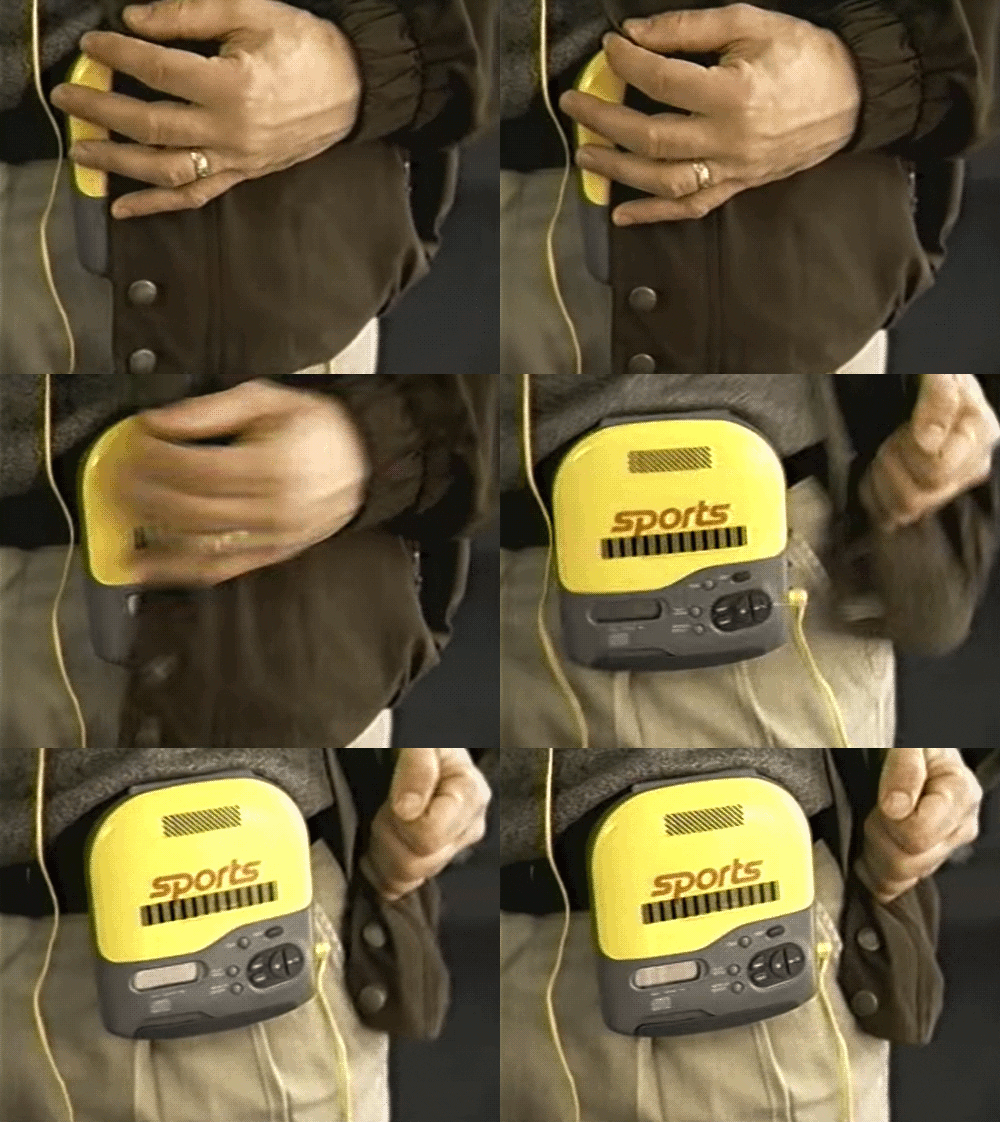
Let me tell a quick story that will tie in nicely. When I was 16, all I wanted for Christmas was a Discman. (It was the 90s).
90s vhs GIF

All my friends had one and as cassettes were going out of style I thought I'd finally be cool. I'd be able to buy CDs instead of sitting with blank cassettes with my finger on the record button waiting for the DJ to play my favorite song, and for the DJ to STOP TALKING SO I COULD GET THE INTRO.

It was a different time.

So, Christmas morning, I came downstairs, and my dad handed me a box. He was giddy. Now, my dad taught weapons at West Point and was a corrections officer. He didn't do giddy, so obviously my anticipation started to build.

He then said, "This is what you wanted. I hope you like it!"

excited happy birthday GIF

I ripped the paper and saw a box. I didn't even look at what the box said - I just kept on ripping. I was finally going to get the thing I really wanted ---- Dad was on the edge of his seat, trying not to smile (which was standard operating procedure), and I got inside only to discover that Dad and I had a clear misunderstanding.

My dad thought he understood what I wanted. He was excited. He did not understand what I wanted.

I wanted a CD player.
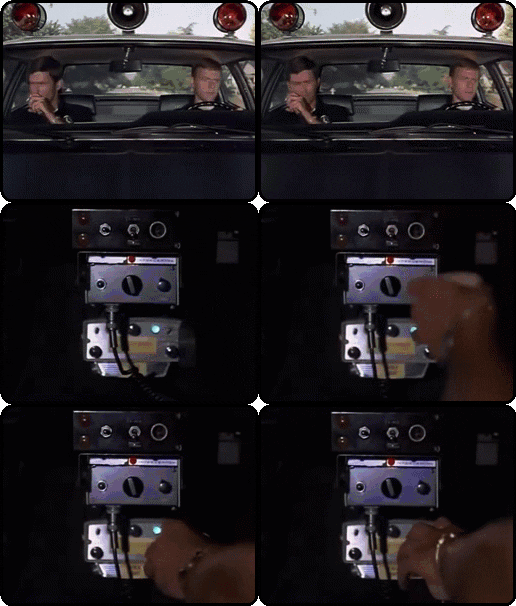
He gave me a CB Radio.

Very different media devices.
radio GIF
My handle was "Little Cricket." 

I wish I could say I handled it well. But, I was 16, my hopes were pretty high, and so I ran to my room and cried for an hour. Not my proudest moment.

Now let's go back to this idea of the hierarchy of awesome. 

If we are giving our dogs what we THINK they want, assuming that it's rewarding to them because we tell them it's rewarding, because it's a present from us, then we might be missing the mark. We aren't reinforcing anything at all.

So, how do we find out what is really rewarding to a dog?

We sit down with members of the household and figure out their top 5 favorite things. Is it rolling in goose poop? Is it playing chase? Is it chicken?  Is it chasing chickens? How about cheese sticks? Sniffing things? Digging? How can we use what dogs find rewarding to our benefit? Nothing is too gross or weird. Really take some time to think about what your dog truly loves.


Above is a video of me creating a hierarchy of awesome with my 7-year-old daughter, Acey. In it, we discuss how certain things we can use in specific situations, and how things (like marrow bones, which are highly reinforcing to Captain, might work well for duration behaviors, but not so convenient for taking out on walks). I then use an example from this morning as to how I used the game, "Find It", Captain's favorite thing, to get him distracted when "Leave It" wasn't working.

When I think back on that CB Radio, I learned a LOT about the idea of rewards. They are always in the eye of the recipient. I also learned to be gracious, but dogs don't need to be gracious. They'll tell you they don't like it (or don't want it right now) by walking away, ignoring you, all those things humans just are taught not to do. So we have to start thinking of what they like, what will they really work for, what is really rewarding to THEM, not to us.

Think back to Harry Potter books: When Ron was given yet another homemade sweater his mother made him, he was bored, or just embarrassed. Yet when Harry got one, he was elated! That sweater meant he had a family. Identical gifts, one recipient rolled his eyes - the other was over the moon.

Weasley jumper | Harry Potter Wiki | Fandom

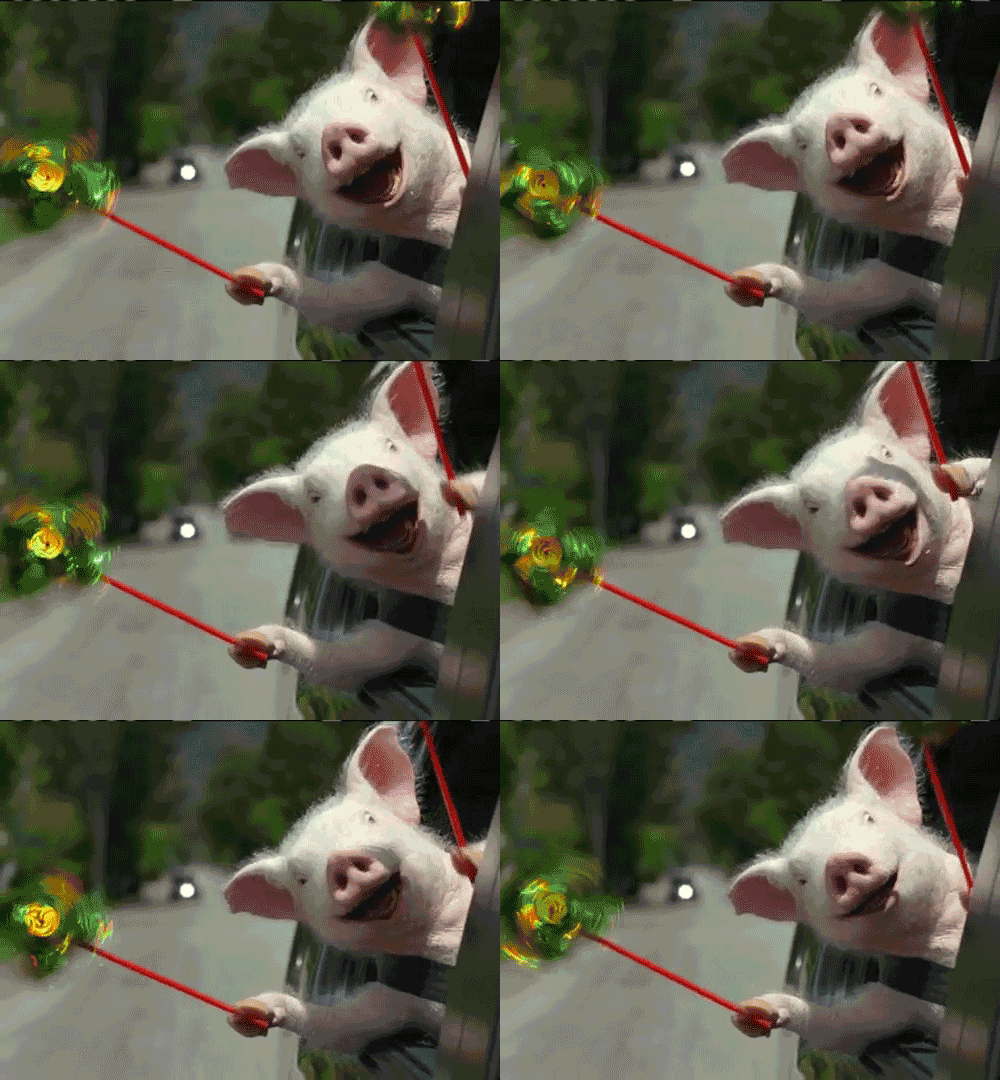
Funny epilogue: When I moved to Ohio to go to college, I owned a Ford Festiva. It was the size of a toaster and about as safe to drive as one. I did ultimately put the CB radio in the car for those long drives across the country to and from school. My college roommates superglued a whirliegig to the antenna in college, which at first really made me upset as I was trying to fit in, but ultimately I learned to love that little car and the stuck and also functional as I could find my shoebox car in a parking lot. Plus, it was fun to yell "Wheeeeee!" as I rode down the road knowing the whirliegig was spinning away. Not unlike the piglet from the Geico commercials. 


piglet GIF

So, take some time today and figure out the hierarchy of aweome for your dog. Every dog's list will be different. Captain's is in the video, but Sadie's would have been: 

Frisbee
Ball
The other ball
Chase a cat
Squeak toy

(Which is why when we did nosework, we used a tennis ball for a reinforcer, not food). 

For Zeppelin, our greyhound:

His bed
Access to couches
Your bed
Hot dogs (which we used for nosework) 
Cheese

So, make your list. I'm curious to see what your lists look like! 
 -M3

10.12.2017

Naked Diner Podcast

A few weeks ago, Andy Hall of the Naked Diner Podcast asked me to participate in a discussion.

Now, this is not exactly my typical audience. Generally, I tend to talk with dog people, schools, or present to pet-related podcasts. This particular podcast is a comedy podcast but they have had amazing guests, such as Trae Crowder and W. Kamau Bell.

So, when in Rome...


The questions we addressed in this particular discussion went from "So, are puppy mills bad?" and "can dogs take pot?" to, "What's a Blue tick? Is that a dog or is someone on the Internet Rick Rolling me?"

Oh, and we all swear like Pirates, so if that's not your jam, you might want to sit this one out. But if you are into the NSFW interviews and also want to hear a dog trainer talk about dogs to a not-dog-training audience, then here you go!

We start the conversation at 9:00 with perhaps my favorite quote from Andy. 

"I posted on my personal Facebook page about talking about dogs. You know? We've had a lot of people, famous people on this podcast and no one ever has questions...You mention dogs, and everyone comes out of the woodwork."

This was perhaps the most fun I've ever had talking publically about dogs, how to become a dog trainer, how I got started as well as what dominance theory is (and more importantly, why it's bunk!) and all the soapboxes you have known and loved on this blog for the last 11 years. They are addressed in full, with both seriousness and humor. It was a joy!

So,  Andy and Jack? Thanks so much! See you guys again soon!
 -M3

1.09.2017

Closer to Dog

A few weeks ago, I had the pleasure of meeting Jaclyn Smith from "Closer To Dog," a podcast about people who work with dogs, coyotes, wolves and other canids. She takes a look at everything from a day in the life of an Animal Control Officer, to Slobbr - an app for dog owners that assists in finding dog-friendly outings, eateries and veterinarians. She has a great tone, out-going personality and is naturally very curious.


It was, by far, the most fun I have had recording any interview.


Jaclyn came to a disc dogs class at Everydog, and then we interviewed in the family MINI Countryman because the boxing gym next door was...well, let's just say it was in full swing. And by swing, it sounded like sitting ringside for UFC Fight Night.

The MINI is a fantastic place to record, as long as you don't mind the occasional passersby peering into the car (that is fogging up due to two grown adults talking to into microphones for 45 minutes). I really hope that someone passing by had a great story to tell.

"Heya, Mike? Out there, that fogged up car...what do you think they are doing? Yeah, they were each holding a small ferret and talking into it. What do you think that's about?" 


So without further adieu, here is the link to this week's "Closer to Dog", all about disc dogs (but really, so much more). If you like it, go back and listen to some of the other episodes. They are fun and informative. You might even recognize some of your favorite Boston-area dog-folk like Michelle from Slobbr, and Zee from Wolf Hollow sanctuary in Ipswich, MA.

 Enjoy (and laugh!)
 -M3

3.15.2016

What DO City Dogs Need To Know?


A few weeks ago, I wrapped up my 5 part series with @2DogsTreats where we covered the elements in dog training necessary for living in an urban setting. Here they are in full with some funnies to get you in the mood for a little pup training! 

1. Name recognition (it sounds totally basic, but what do you want your dog to DO when you say his name? If "ignore me completely" isn't your answer, then check this out.)


2. Leave it (or affectionately called The Chicken Bone Command)


3. Wait 


4. Come (not "Come, please come - come back, *#&$^!!!! He's Friendly!)


"I'm not even going to try. Come back when you're ready, Sparky."

5. Heel.  (I might be playing favorites, but I really like how this one turned out.)


If you're so inclined, feel free to work on one or more of these elements for homework! 


Best, 
- M3

3.12.2016

Notably Missing From The Cesar Millan Investigation "Reporting"

There is a post going around my Facebook feed (which is admittedly 85% dog

(Reporting varies, stating the ear was "nipped and bled," all the way through to "bit a chunk of the ear off". I can't find a reputable source on  severity of the pig's injury.)
In all the reporting of this story, there is one thing that absolutely has to be addressed that's gone on for far too long. This is the thing that would perhaps quell some of the discussion of if Mr. Millan is "abusing animals" or if he's "God's gift to canine kind." The one thing that needs to be addressed is this:


Any and all reporting on Cesar Millan needs to stop referring to him as a
"self-taught behaviorist".

In the dog industry, a behaviorist is someone who:
  • Has received a certification from a science based group, usually after presenting 1500+ hours of dog behavior documentation and taking a lengthy exam going over stress signals, medication, anatomy, physiology, tools, and teaching ability.
OR
  • Has a PhD in an animal related field (like zoology)
OR
  • Is a Doctor of Veterinary Medicine who is accredited as a veterinary behaviorist through the American College of Veterinary Behaviorists.  There are only around 75 certified behaviorists through the ACVB, and Mr. Millan's name is not on the list.

The news outlets reporting on this really need to ask questions and educate the public about the following:

  • What is a behaviorist?
  • How do I find a reputable one?

By explaining what a behaviorist does and who a behaviorist is, we can avoid the tired argument of if Cesar helps dogs or not. Instead of a really emotional argument based on ambiguity, there are terms that should be defined in the reporting, and that might help clear some things up regarding Mr. Millan.

In short, Mr. Millan can call himself a behaviorist.
I can call myself an astronaut.
Neither are true.


And here is a link to Considerations for the City Dog- a book that dedicates an entire chapter explaining the differences of these professionals.


In short, if you are looking for behavior help, look for credentials and know what your behavior professional had to do before earning the  "Behavior Consultant", "Applied Animal Behaviorist" or "Veterinary Behaviorist" title before hiring. Do your due diligence for your dog's sake. If someone calls himself or herself a behaviorist, ask what they did to earn the title, and who gave them the credentials.

Good luck,

-M3

2.29.2016

What's Next?

You might remember a few months ago when there was a hilarious snafu with the US Postal Service that accidentally sent the woman I look up to the most in this industry a box of dental supplies with my name attached instead of a copy of the book I wrote. 

It could have been SOOOOO much worse than dental supplies....

Well, snafu aside, this entire experience led to a rather wonderful email back and forth between me and Dr. Patricia McConnell where we discussed in great detail some of the specific things that make living in a city different for dog owners compared to rural settings. It was really a wonderful conversation and without the Internet, might never have happened.

Thanks, Al Gore! 

She ended up writing a fantastic piece on her vantage point as an animal behaviorist from Wisconsin visiting New York City, and included some of the snippets of our back-and-forth.

(I might have swooned, but I did keep it totally cool. I think.) 

184989c8a499a6130bf5005552e314b2.jpg (236×240)
Me. Trying to "keep cool."

What came out of it was a question she asked in our conversation. A simple question, one that seemed so freakin' obvious, but after being in the city for so long it just never occurred to me to look at things from this particular angle. Her question was this: 

"Do you have a section in it that includes a hierarchy of skills for city dogs? I looked, couldn’t find it anywhere. What you said below is SO valuable! Did I miss it in the book somewhere? The only (minor) critique I’d make of the book is that I can’t find that much info that really is about ‘city dogs’ versus suburban ones. Again, it’s GREAT info, but I couldn’t find city-specific info as much as I wanted it. (ie, broken glass every where.. I NEVER would have thought of that…) Just asking, and possibly a thought for its eventual reprinting?"

Duh! Commands! City Dog Commands.
So my friends at 2 Dogs Treats gave me the latitude to address exactly that question. "What IS the hierarchy of urban dog commands?"

In the coming weeks, I'll be cross posting from the 2 Dogs Treats Blog the urban dog commands hierarchy, and ways to teach these skills. They are longer posts, often with videos and humor. I hope they can help you out. 

And yes, I'll do an eventual 2nd edition of "Considerations for the City Dog" because...my hero suggested it :)

(No longer keeping it cool. That's the last time I'll mention it, I swear. SQUEEE!)


THANK YOU!
 Seriously - all of you who read, recommended, reviewed or even helped create Considerations for the City Dog,thank you from the bottom of my heart. Thanks to you, we got up to 25 reviews on Amazon, which means that Amazon *should* start recommending Considerations for other readers who are searching books in the same category!

That doesn't mean you shouldn't review if you haven't. Amazon has tiers of how they promote books to other readers, so the more reviews the better.  If you're so inclined it only takes a moment to review on Amazon and Goodreads and it helps more than any single thing (aside from picketing outside of publishing houses changing "City Dogs Rule!")

While you're at it, review a few of your favorite books, especially if they are written by indie or "self" published authors as they don't have the long arm of a PR firm or publishing house to help get the word out. I put "self" in quotes because I think it's the biggest misnomer in the book industry. It took a team of 15 to get Considerations for the City Dog up to snuff, and bless their hearts, they all volunteered because they believed in me or the concept of the book. If there is a book you love and believe in and you know it's by an indie or "self-published" author, consider giving a quick review so they can perhaps reach that magic number. For all of you who reviewed or recommend in any way:


Thank you :) 

-M3

11.30.2015

Rewards

As a dog trainer, I talk a LOT about rewards.

In short, a reward is in the eye of the recipient. I think of Ron Weasley from Harry Potter and the hand knit sweater. He REALLY didn't want the sweater his mom made him for Christmas - he got one every year and was embarrassed by them. Harry, never having a sweater, really was touched by the gift Mrs. Weasley made him.

Last night, we had a good lesson in "rewards."


Aislyn, my three year old daughter, is trying a full night without her bedroom light. I told her she had to pick her binky or the light (she picked binky) AND she gets a reward of whatever she wants for breakfast tomorrow morning if she can make it through the night.

"I want a Nutella and orange cheese stick sandwich."

"Can I just make you a peanut butter and Nutella sandwich?"

"No. Nutella and cheese stick."

"Ok, Nutella and cheese."

"NO, Mom. Cheese STICK."

So, a reward I never .... never would have thought of - a Nutella and Cheese STICK sandwich.

Now, I could have given her a new toy. I could have given her a peanut butter sandwich. I could have had a dance party with her. Those things would not have been as rewarding as a Nutella and cheese stick sandwich.

Dog help us if we were out of Nutella. Or cheese sticks.

Luckily, she decided at the last minute to have the cheese stick on the side so it didn't get messy.


This is a real reward.

Think about that the next time your dog won't come when called. Was he expecting a game with you and you just pet him on the top of his head? Is that head rub rewarding at all to your dog? We know you think it is but does your dog perceive that as a reward?

Does the behavior of "come" increase or decrease with a head rub instead of a game of tug or a piece of cheese?

11.13.2015

Muzzle Up!

Here is a post I wrote for 2 Dogs Treats last week. I thought it was an important one to share here in its entirety. 

Muzzle Up!

If you are reading this right now, you might think muzzles are only for “bad dogs.” Dogs that are aggressive, dangerous or mean.

I hope to change your mind by the end of this post.

I will introduce and discuss the many reasons for acclimating every dog to a basket muzzle, particularly in an urban environment. Your vet would argue (rightfully) that all dogs should be comfortable wearing a muzzle and I have to agree.

labrador-basket-muzzle.jpg
A Labrador Retriever wearing a Basket Muzzle. 
(Courtesy of TheLabradorSite.com)
Before I list the many reasons that pet professionals are pro-muzzle, I want you to think for a minute. What circumstances would a muzzle be useful? Think about veterinarians, the law, natural disasters. Now can you think of any other reason to muzzle train your pup?

Here is a short list:
  • Veterinarians might have to muzzle your dog if he is seriously injured. When our greyhound broke his leg at home, my instinct was to grab his basket muzzle, put it on him, and then evaluate the situation. When a dog is in excruciating pain (such as a broken leg), their instinct is to prevent more pain. Even the best behaved dogs that would never otherwise bite their owners have bitten owners, passer bys and veterinarians - all of which were trying to help the dog. You can’t help your dog if you are also going to the ER for a significant dog bite, so put the muzzle on Sparky first and then assess the situation.
  • Dogs that eat EVERYTHING. If you have a dog who has had to go to the veterinarian more than once this summer for parasites because your dog eats everything on walks, a muzzle might be a great option for preventing illness and more vet bills. This also applies to labradors who eat rocks, poop (coprophagia) or other forms ofpica.
  • Local evacuations: With more and more natural disasters nationally, the chances of evacuation due to natural disaster are (sadly) increasing. Many people do not want to leave their pets behind in case of emergency, and many choose to ignore evacuation requests because of their pets. Don’t risk your life, or your pets life. Many evacuation sites will allow you to bring your pet IF it’s in a crate and muzzled. When a dog is stressed out, the likelihood of a bite increases so for everyone's protection, your pets need to be muzzled and / or crated. If you haven’t started crate training, here is a great place to start.
  • Reactive Dogs: There are aggressive dogs (dogs that for a variety of reasons charge and bite) and there arereactive dogs. Dogs like my former dog, Sadie, who had a large personal space bubble and was perfectly fine as long as no other dog came into her space. If they did, then she would react by lunging, barking, and loudly express her displeasure at the intruder. It’s an even harder situation when the dog coming into her space is a “friendly” dog who “just wants to say hi.” Sorry, this might be unpopular, but as the owner of a reactive dog (like thousands of you in cities) your dog’s friendliness has absolutely nothing to do with my dog’s comfort. Your dog’s “good intentions” is not permission to come into any dog’s space. Full stop. This is why leash laws exist - it’s not just for the safety of your dog, but for the dogs that are uncomfortable their surroundings. If you do not have the ability to call your dog from any distraction (including other dogs) your dog should be leashed until trained. With that said, as an added bonus, a dog like Sadie could have worn a muzzle - which would have been a visual cue to the FDO (friendly dog’s owner) that this dog should not have her space infringed upon. Sometimes a little extra security goes a long, long way.
  • If you are in a busy environment and other people ignore pleas to not get in your dog's face. If you are someone who says “yes, I know he’s cute, and he likes people but I think he’s overwhelmed now,” a muzzle is a good visual marker for people to give a little bit of space so this dog can take a quick break.
  • Bully Breeds: If you own a bully breed, or a banned breed (there are 75 of them in the USA - is your dog on this list?), a muzzle might be a necessary evil for you to keep your dog. In some cases, you can only walk your banned breed down the street of your neighborhood, regardless of temperament, with a muzzle. If you think breed bans are just for ‘pit bulls’ and other bully breeds, then you’re in for a surprise because in some cases, Chihuahuas, American Eskimo Dogs and Golden Retrievers are on the list. If you are the owner of these dogs in a locale that bans these breeds, you are now going to start feeling the heat in the way that bully breed owners have been for decades. It’s time to stop BSL (breed specific legislation) and instead employ individual risk assessment per individual dogs.


pink muzzle.png
Pink, custom, blinged out muzzle for this beauty! 
For more information about this particular piece, visit RedStarCafe

There are great resources for muzzles, including the popular Muzzle Up Project. This website lays out even more resources and reasons for muzzles, and works hard to erase the stigma of muzzles. The Karen Pryor website also is addressing the muzzle issue.

With all of that said, muzzles are still used on dogs that are aggressive, so it’s important to give space to ANY dog wearing a muzzle. Until we can all get on board and ask every dog owner if it’s ok to say hello to their dog (and keep going if the answer is “No,” for any reason!), then muzzles are a necessity.

And, in some cases, are really, really cute :)


2 Dogs Treats owner Christian enters J-Lo in a Halloween contest. J-Lo is wearing a Duck Muzzle - a functional muzzle designed to take some of the stigma out of muzzling dogs. Good boy, Christian! You’re doing an AWESOME job advocating for your pup!

So next time you see a dog in a muzzle, there is no reason to be alarmed. The owner is protecting their dogs from illness, good intentions and eating terrible things. They are advocating for their dog’s space. They are teaching their dogs that muzzles are no big deal in the event of an emergency. These are good dog owners who are being proactive and protective for a variety of reasons.

Training goal: Get a muzzle and start teaching your pup to wear it. You don’t have to have your dog wear it all the time, but you can start getting your dog used to it. Your vet, trainer and others will thank you for it in the event of an unforeseen circumstance. The time to try a muzzle is not when you’re being evacuated or your dog has broken his leg - the time for muzzles is when you can teach them to wear it comfortably, and treat it like a party trick.

Until next time! 
Melissa McCue-McGrath, CPDT-KA
Author Considerations for the City Dog | Co-Training Director NEDTC.org | Co-Conspirator at CarTalk FIDO