Showing posts with label Leash Walking. Show all posts

11.04.2014

Excerpt: "Considerations For The City Dog: Chapter 7"

Hi Guys!

I've been working on a book since the Rocco Case in Somerville last November, which is why I've been M.I.A. on this blog for so long. I wanted to do something to prevent that from ever happening again.

Will this book change every single person's habits with dogs in the city? No. But this book is designed to be a companion piece to training. It won't teach you how to get your dog to sit, come or stop rolling in gross stuff. It will get you to think about the things urban dogs go through on a daily basis when they live in a city, professionals you need in your corner (what is a "behaviorist vs. trainer"), and how to find reliable resources in your community. Many of the chapters are expanded versions of past blog posts.

Yes, this is a more global book, in that all dogs and owners can benefit from Considerations, but it pays particular attention to the dogs in our urban centers, where they are coming from, what our students are seeing, and what vets/behaviorists/trainers/other dog owners are seeing in our back (concrete) yard.

Here is a blurb from Chapter 7 (He's Friendly!)


Yes, I really wanted a dog who loved other dogs. I envisioned a life of going to the dog park, and off-leash hiking. I wanted to take her to doggy daycare and drop her off to play with other dog friends while I traveled - but that’s not the dog that I ended up with. I couldn’t make her love other dogs no more than my parents could make me love spiders, but I was able to get her to tolerate living around other dogs with very particular parameters. One of those parameters was that she was afforded just a little bit of space that wasn’t infringed upon by other dogs. Even friendly ones. Sadie wasn’t, and isn’t, the only dog in the city that has an owner working incredibly hard to give just a little bit of space. It’s really hard for dog owners, dog lovers, to say “no, please, stay away!” I find that this is one of the more challenging parts to owning a dog who needs space in a city of friendly dogs. People think they did something wrong because their dog is different and their dog needs space unlike the other dogs in the fields, parks, and hiking trails. People hate to say “no- stay away” because as much as the dog needs space, these are dog-loving people who love other dog-loving people. It’s hard to turn your back on your “tribe”.

I found the only thing that worked to give Sadie her personal-space-bubble was to stand my ground, and firmly state “Not Friendly!” to every oncoming dog owner. I used to feel terrible for saying it- like I was proclaiming on a mountain top that I had a bad dog, which I emphatically did not. Once I realized that Sadie wasn’t alone, and that she was a wonderful dog who happened to need a little space, like thousands of dogs in the Metro-Boston region, I stopped feeling guilty. Wavering, or saying “she’s sort of friendly but doesn’t like black dogs, or men with hats….” doesn’t work because if there is any wiggle room, well-intentioned dog owners will take it upon themselves to suggest that their dog is the exception to the rule. To be fair, I live in Boston and subtlety is not a Boston thing. However, the most important factor to her safety was that she was given 8’ of space (the length of her leash plus my arm), and that I remained her advocate, always.

 Considerations for the City Dog, Chapter 7: "He's Friendly"
       -M3

9.06.2012

Loose Leash Walking Equipment: Harnesses


Often, dog owners will get a harness to help their dog. Sometimes the dog is pulling excessively, or is choking himself, but the type of harness matters significantly to help curb problem behaviors while walking.


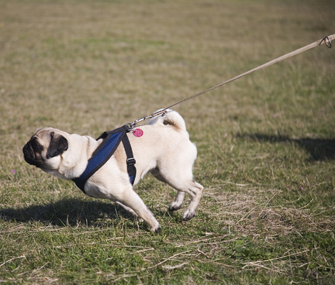
This harness clips to the back, is made of nylon, and is REALLY comfortable - 
especially if the dog enjoys pulling on a leash 


Compare the above harness, which clips to the back of the dog, stretchy, padded in all the right places to the harnesses in the below photograph, which clip to the back of the dog, are stretchy, and padded in all the right places.


"Wheeee! Pulling is FUN!" 

I'm going write about other walking devices in follow up posts (Harnesses, Head Collars, Aversive Collars, and Other Training Tools) so you can hopefully find the right walking/training device for you and your pup.

Harnesses:

There are thousands of harnesses to chose from - some of them stating that they are "No Pull", some are nylon and stretchy, and many are just damned cute. Some are step-in harnesses, and some slide over the head of the dog. The possibilities are endless!


Puppia Harness 


Rogz-Dogz Utility Harness 


If you have a dog that walks beautifully on leash, doesn't pull, and is trained to walk with you, a standard back attach harness might be a good option for you (see the options above). Our greyhound walks with a back clip harness because he does not pull, and has a neck injury that tends to get aggravated when he is walked with his standard collar.

If, however, walking your dog feels like a form of medieval torture, you might wish to try a harness designed to take some of the ease out of the pull (and your rotator cuff).


Sensation Harness. Available at some boutiques and online. Fits better on adolescent and skinnier chested dogs than the more commercially available Easy Walk.


Easy Walk Harness. More commercially available than the Sensation, not appropriate for "skinny" dogs . Better for dogs with a broader chest.


Sporn No-Pull Mesh Harness: Pulls the front legs up when the dog pulls. Some dogs are sensitive to the pressure put on the legs, and it can chafe.


I'm a huge fan of the Sense-ation Harness. This harness is a front clip design, where the leash attaches to the chest of the dog instead of on the back. When the dog pulls, his momentum is stopped. I used a harness like this on our Border Collie with fantastic success. Some other examples include the Easy Walk Harness (from our friends at Premier, and clips to the chest) , and the Sporn Harness (clips to the back, pulls dogs front legs off the ground when they pull).

It's important to note that some dogs suddenly and miraculously walk much better when on a harness. However, most dogs will do well with this equipment as a device to help TRAIN the dog not to pull. There are several humane methods to teach your dog not to pull. This is one of my favorite methods for real life training outside.


Pros:
-The leash attaches to a ring on the back or chest of the dog, leaving the esophagus, airway, and neck vertebrae at minimal risk of injury.

-For dogs with spinal injuries or other medical conditions, this is a good alternative for walking with a collar around the neck.

-Some sports or work require the dog to be in a harness (Skijoring, Tracking, or Search and Rescue work to name a few), and all of these harnesses encourage pulling. This is a "pro" if you are engaged in an activity/sport where you need the dog to pull.

-Many of the Chest Clip harnesses (like Sensation and Easy Walk) slide comfortably over the head of the dog - no more pulling the harness through each of the front legs.


Cons:

-If you have the wrong harness, it can encourage pulling behaviors, making it difficult to walk your dog.

-Step-In Harnesses are inconvenient to get on and off of a dog.

-Can cause chafing in some dogs.


Stay tuned for more on walking devices!


---------------------------------------------------------------------------------------------------------------------------------
Melissa McCue-McGrath, CPDT-KA is a certified dog trainer in Somerville, MA and can be found teaching dogs through the Boston/North area. 

4.25.2011

Leash Your Dog. No Really, Leash Your Dog.

Consider this:

A leashed dog is walking in a park with his owner. An off-leash dog sees the leashed dog, and starts happily bounding towards them. The owner of the off-leash dog goes bounding after his dog - "Nelly, COME!" but Nelly ignores her owner. She is so excited about the new dog, that she runs up. Nelly's owner changes tactics - "It's OK - she's friendly".  The leashed dog might be excited to say hi to a rapidly approaching happy dog - or, the other dog could growl, bite, or show other displays of being uncomfortable with an oncoming strange dog.

The leashed dog might be on leash because it's illegal to be off-leash in most parks and the owner might be a law abiding citizen. The leashed dog might be on leash because he's not friendly and doesn't appreciate other dogs in his face. The leashed dog might be on leash because his recall isn't so great. The leashed dog may do much better with other dogs off leash, but it wouldn't be a problem if Nelly was also leashed, or had a decent recall.

Why NOT leash a dog? Leash sets can be STYLIN'! Not to mention it's illegal in most urban places to have your dog without a leash...and dangerous if you don't have a reliable recall.


There are several sightings on the streets of Somerville, a particularly busy city for those not familiar with it, where people walk their unleashed dogs on the sidewalk. One woman has a very sweet Cocker Spaniel that she "walks" - the dog is 15' ahead of her, she's trailing behind chatting on her cell phone. Her dog is sweet, and she'll say so when her dog is running full tilt across the busy street to say hi to other dogs. I've told her twice that not all dogs are friendly with unfamiliar dogs jumping in their faces, mine is one of those dogs. Not to mention it's dangerous that her dog is crossing city streets, not only for her dog, but for drivers that might swerve to miss her darting pooch and hit a pedestrian or another car. The second time this happened, I told her I'd call animal control the next time I saw her unleashed dog. I saw her a week later. Her dog was leashed, but as soon as we passed her, I turned around, only to see her unhook her dog, and the dog run down the sidewalk.

I knew a guy when I first moved to Somerville that would take his happy dog, Shred, to the unofficial dog play group at Foss Park. Shred was never more than a couple feet behind his owner, and he never used a leash. He didn't have to because Shred was right there, all the time. One day, they were crossing McGrath highway on their way home from the dog park. They had the crossing light, but the minivan that ran the red light didn't care.  The owner ran forward to avoid the car, Shred didn't move and got hit. Had he been leashed, the owners forward motion to get away would have at least pulled Shred enough to maybe miss the oncoming van.

I'm all for allowing a dog to run, to play, to be a dog. However, like most things, this has to have rules. Your dog should be allowed to be off leash in the city where all the conditions are met:
 -Your dog is friendly to people and dogs
 -Your dog is under voice control. One command, one action, example: "Sadie, Come!". The following is not a recall: "Please, Sadie, Come! I said Come - no, COME! SADIE - &#!$? Come here NOW!"
 - If your dog is not under vocal control, use a 30' long line to work recall with your dog. Get into a recall class or attend a free recall clinic (we offer them several times a year in Somerville through City Dog Training).  Get into a sport like Frisbee or Agility where your dog is allowed to run, jump, play, and go full tilt - but you can stop it with your voice, and your dog learns attention in a fun way.
 - You are in a dog appropriate place - NOT the sidewalks of your city. Too many things can go wrong. Off leash hours at local parks, play groups, hiking trails that dogs are permitted off leash, dog friendly beaches, fenced in dog parks, etc. are appropriate off leash outlets for your dog, if your dog can handle those situations.
 - Some dogs, like sight hounds, should never be let off leash in an unfenced area. Seek out safe, fenced in  places for your FRIENDLY dog to run. Note: not all dogs will do ok in a dog park, so if your dog is sometimes ok and not others, don't take your dog to a dog park. Work with a trainer to figure out where your dog can get appropriate exercise without putting other dogs at risk.
 -You are paying attention to your dog's behavior and your surroundings. If your dog is off playing with other dogs, you should not be on your cell phone, doing a crossword puzzle, chatting with other people without noticing where your dog is. You might want to pay attention to what he's rolling in, if he's chasing a bike, chasing a dog, chasing a squirrel, or where he is pooping. In the city, it's still your responsibility to clean up after your dog, even if your excuse is your NYT puzzle, E-Reader, or phone conversation was too distracting.  Off leash time is not the time for you to check out, no matter how long of a day you had. Wait until your dog is exercised, then go home, have a glass of wine, and tune out the world or talk to your friend on the phone.


Where to exercise your dogs off leash in our area?

 Nunziatio
 0 New Washington
 Ed Leathers Park
 Danahy Park

Summary:
For all the people who have friendly dogs in the city - please, keep your dog on leash. For those who have unfriendly dogs in the city, please keep your dog on a leash. If your dog is off leash in a park, any park, your dog needs a 100% reliable recall. Your dog needs to be on a leash in the city on walks, end of story. It's not just for your dog, it's for the safety and comfort of all the dogs around you, not to mention not having your dog on leash on the sidewalks is illegal for all the reasons I expressed and more.

Lastly:
As my dad said every New Years Eve: "Be careful. I'm not worried that you would drive under the influence- it's the other people that are driving drunk that I'm worried about". Your dog might be excited to say hi to every dog and person he meets, but the other dog might be aggressive, shy, or reactive. Other people might not enjoy your dogs enthusiastic jumps, might be allergic, or have been attacked by dogs in the past. If your dog is friendly, find appropriate places to unleash your hound, but ONLY if you have reliable recall. If your dog isn't friendly and needs to run, get a trainer, and get into a dog sport like Frisbee, Agility, and other sports so you can learn how to control your dogs impulses while still getting exercise.