1.31.2011

Dogs and Weddings: Do They Mix?

So, we're engaged, and I couldn't be happier. I'm guessing Sadie is happy as well, considering she's the one who picked him out of a crowd, ran up to him, said hello, and the rest is history.

Everyone has asked if Sadie and Zeppy will serve as Flower Beasts or Ring Doggers. I've advised several clients NOT to have their dogs in their wedding because, knowing their dogs, they would have been totally overwhelmed and wouldn't have a good time.


"Sadie", 8 year old Border Collie: She picked my man. How can you say no to a face like this?


As much as I keep saying to my clients that dogs and wedding's don't really belong together, I can't help but think that our two dogs really do belong since they are such a huge part of our life and that there has to be a good way to decide if your dog is an appropriate addition to your wedding. You know I love lists - so here's another one:

-Your vision: Do you imagine a big, poofy, cake topper style wedding gown, a two mile cathedral train, lots of glitz, and a black tie mandatory ceremony? Or does your vision include a relaxed event in your parents back yard/nice park? White dogs and black suits don't work out well, and the same goes for black dogs and white dresses (shedding). Fur on everyone's suits and dresses, muddy paw prints on rugs, and, let me remind you, off leash dogs love to help themselves to buffets!

 -Is your dog ok with crowds? Does your dog get over-excited around specific people? Will that be manageable during your vows? Is your dog terrified of strangers?

- Is your dog trained? Silly question, I know, but if your dog is prone to jumping, do you want even the smallest jumping dog to get their nails stuck in your dream dress? Can your dog settle or down-stay during the vows without saying "STAY!" every 2 seconds? This moment is for you and your partner, and should be savored. You definitely don't want to split your focus between one on of the happiest moments of your life, and your dogs inability to settle and be quiet for 10 minutes.

 -Do funny clothes make your dog freak out. I once trained a Rodegian Ridgeback as a puppy, and later found out that she wasn't too keen on having women in poofy dresses near her. She was evidently tied up to a table at an outdoor cafe. The church across the street rang the bells and out walked a bride in a BIG ballgown dress, which this dog did not appreciate. The dog pulled the table part way across the street before the owners got to her. This is a dog that is bred to hunt lions in Africa - you don't want to piss it off, especially on your big day! Also, if your dog doesn't like people in hats, they certainly won't like you in a veil, even if "they know it's you". For all your dog knows, that veil has you by the face, and the dog might dutifully bark at it until it releases you from it's grasp.

-Who will handle your dog during the ceremony/hand-fasting/ring exchange/broom jump/glass smash, etc? Also, does that person like dogs?

-Where will the dog go after the ceremony/photos are done being taken? Do you want to be watching your dogs for the entirety of the reception, or worry if the dog got loose because Aunt Madge left the reception door open?

-Is Grandma allergic to dogs? Does anyone have a phobia of dogs? Was Uncle Timmy attacked by a dog as a kid? You should let your close family know that a dog is attending. There may be a point in the planning when you have to decide "Uncle Timmy or Fluffy."


-If your dog is terrified of men/children/old ladies and walkers, don't have your dog in your wedding where there will be lots of men, children, and grandmas walker.

-Does your facility allow dogs? Many churches and hotels do NOT allow dogs. It's best to ask first instead of arriving at the facility to find out Fido isn't allowed.

-2 words: Poop Patrol. You DEFINITELY want to make sure Sparky has done his/her business before the ceremony, since you don't want to be carrying a poop bag instead of flowers to the alter!
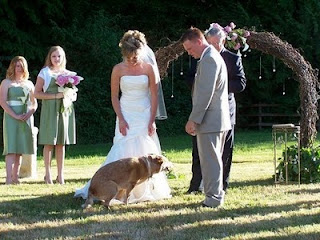


-Are your dogs a big part of both of your lives? It's not fair if one partner has a dog, and the other partner doesn't even like the *$&%*%# ankle biter.


Sadie is really overexcited by lots of people, which isn't a problem for us because we will likely severely limit the ceremony to only a few people (less than 8 total) in an outdoor, leashed dogs allowed, arboretum. The next day, we will be shuffling off to our reception, and the dogs will not be attending. We want people to have a fun time, and I don't want to be dog-sitting instead of talking to family I haven't seen in a year.


Zeppy will look smashing in this little number!

If your dog is a big  part of your life, and that fits in with the type of ceremony/wedding you'd like to have, AND your dog is comfortable in the type of vision that you have in mind, then by all means, accessorize that beast and enjoy having Fido as part of your special day. However, if your vision is something that your dog is forced into, will be stressed out over, someone will have to babysit, and the overall feel of the wedding isn't dog appropriate, then for the love of dog, don't bring your four-legged friend. Instead, you can honor your pooch with a centerpiece photo, or in the program.

Do you still need help deciding? Imagine the worst possible thing your dog can do or is likely to do during your big day. Do you think you'd laugh, or be mortified? If you think you'd laugh, bring the dog. If you'd be worried, mortified, annoyed, or bothered - or other people will be mortified, annoyed, worried or bothered, leave your dog at home.

Trust me, everyone will be happier that a poorly behaved, or terrified dog isn't attending the events, especially Uncle Timmy.


1.20.2011

Oh The Weather Outside Is Frightful!: Cold Weather Equipment for City People and City Dogs

Here in Boston, we experience several seasons, one of them colder and yuckier than the rest (Sadie, as usual, disagrees.) We have a cold weather dog, and a dog that detests the frigid New England temperatures. Additionally, when you live in the city, there are many different things to consider: walking on concrete sidewalks, especially when covered in a sheet of ice is VERY challenging - and I don't know about you, but the gloves I wear never keep my hands warm and I can't open poop bags (another "city" phenomenon....I never HEARD of a poop bag when I lived in Maine!)

So here are a few tips for winterizing yourself when you live in the City and need to adventure out with your dogs, not matter what the weather!

Muttens:
I have some wonderful friends that thought of me last winter around Christmas time. I take their dogs out for a walk around lunchtime a few times a week, and had let it slip in passing that opening poop bags with gloved fingers is damned near impossible, not to mention when it's particularly windy out, gloves just simply don't keep your fingers warm the way mittens do. Have you ever tried to open a poop bag with mittens? If you take the mittens off to open the bag, your hand freezes. Well, some clever soul created Muttens, and they were my Christmas gift last year - a thumbless mitten that keeps your entire hand toasty warm, with an opening at the top for your hand to easily slide out of to open poo bags, or open doors.

The fleece continues to cover the back of your hands, protecting from the wind, even when part of your hand is exposed. If you walk with a retractable leash (I hope you don't in the city!), you can hold the leash in the Mutten with your hand completely covered by the warm fleece. I didn't need to wear any additional gloves with the Muttens, and I usually wear 2 pairs of gloves when I go out walking with dogs. Absolutely the best way to walk your dogs, and stay warm. Click here for the Muttens website

Yak Tracks
I slip and fall ALL the time on the sidewalks. Some people don't shovel the sidewalk in front of their apartment, some only shovel and don't throw salt down which leaves an icy walking surface where dogs and people can get hurt. A shop owner recommended I try Yak Tracks. You can get them at most hardware stores. Basically, they are a rubber slip on with steel coils underneath to help you get grip. I haven't fallen once since I started wearing these for walking dogs. When dogs pull on the leash on an icy patch, I can still keep my balance because the steel digs into the ice, giving the wearer a grip. I absolutely recommend these for anyone that is prone to falling, or out on icy sidewalks for more than 2 steps. Plus, they are easy on/easy off. I keep them in my car, they slide over my boots and sneakers (the rubber is self adjustable like an elastic band, so no adjusting needed for different shoe types), and I'm ready to go in 15 seconds. Be particularly careful wearing them in the house, though - steel and tile don't mix! Yak Tracks info here


What about my dogs? How do I keep them safe and comfortable?
Snow, salt and ice kept getting up in the pads of his feet, creating microcuts in the pad. Zeppelin finally just stopped walking entirely in the winter. Salt, though good for people to walk more comfortably is incredibly painful for dogs to walk on, and it's a part of living in the city. What can you do to help your pup?

Boots
Now, keep in mind I come from a dog-sledding family, and boots on our dogs was part of their running equipment to protect their paws from sticks, rocks, and frostbite on longer runs. The boots I see in the city with lace and slippery bottoms are strictly for show, plus they don't stay on. Ruffwear does make a great boot for city use - they fit snugly around the foot, and are completely utilitarian. I have several clients that use them and praise them heavily. NOW, keep in mind that not all dog feet are created equally. Sadie has very small feet and very little for the boot to grab onto around her ankle. Even though she's comfortable with boots on, and will wear them without complaint, she throws boots when she runs after Frisbees. Labs, who have a big foot and small ankle, would do better with this type of boot.Our problem was with Zeppelin, who will not walk with boots on, no matter what we tried, and he's super-sensitive to the ice/salt mix on the sidewalks. After three years of trying to find the right equipment for him, we decided to try....

...Mushers Secret, a wax that creates a thin protective layer on the dogs pads and feet. It prevents snow and ice from building up inside the pads, and even seems to help with the salt problems. I equate it to Chapstick, for dogs feet. It won't protect against frostbite, or tons of salt, but it does help quite a bit. Since we have used it, Zeppy has gone from walking 4 blocks maximum to a full 2 mile loop every morning. I admit, I was hesitant to use this product in the city. We used it on the Huskies because they were on powder snow and never encounter salt, which I thought would stick to the wax, creating more damage, but it is working for our particular dog who will not wear boots, and I'm very happy we found something that works.

If you have any other suggestions, or great products for winterizing people or dogs for city life, feel free to leave a comment!

1.14.2011

Dan Savage and The Poodle


If you are familiar with Dan Savage, you know he is raunchy, honest, and hilarious. This is totally not work safe, but a pretty funny story about how a gay man (who doesn't want to be "That Gay Guy"), who hates dogs, ends up with a toy poodle...and the horrific things that can happen in dog ownership.


1.05.2011

To Spay or Not To Spay? That is the Question

I get asked this question A LOT, and I tell them "it's complicated."

For starters, there is a lot of information online. It can be daunting to go through, and not all of it is correct, or some of it is fuzzy. It also depends on where the information comes from. I focus on behavior and training - so most of my point of reference for suggesting a spay or neuter comes from a training perspective. My vet friends will give advice based on the latest scientific information and the health of your pet. Rescue and Shelter groups don't want ANY more homeless pets. Breeders want your dog to look just the right way and to keep the breed pure. Researchers want to discover important and interesting things. It's not too hard to see that information extracted from one expert will differ from another expert. That being said, I've compiled from a variety of sources a list that should help you make the decision to spay or neuter...or not. My best advice is to talk with your vet, and if you are having behavior problems, consult with your trainer, and weigh out what is going to be best for you and your dog specifically.

It's important to say I am not a veterinarian, and am not an expert in the medical field. If you are a vet and have points to add, please feel free to add them in the comments section. I strive to make this blog as informative as possible, and to help the dog owners that read this blog.


Myths:
My dog will become fat and lazy if altered too early:
  I hate to be the bearer of bad news, but your dog will be just as energetic post surgery than before the surgery. Case in point: my friend Matt and his neutered Frisbee dog, One Eyed Jack.. Not only does he not have his balls, but he also is missing an eye, and as you can see in the video, he's not slowing down for anyone!
If spaying or neutering calmed dogs down and made them lazy, Border Collies and Jack Russell Terriers would be WAY more popular in urban environments. I'd also probably have a Viszla to sit at home, fatten it up, and just watch football on weekends instead of the requisite 12 mile hikes the un-neutered ones need.

My female dog HAS to have a litter/heat cycle before she's spayed: 
 The theory behind this is "it calms the dog down" or "she becomes more mature". This is especially frustrating to hear when it's in regards to a bitch having a littler of puppies. First of all, on average, a female dog will have her first cycle between 6 and 15 months old. By the time the dog has her first litter, she'd be more mature regardless of if she has a litter or not because she got older, not necessarily because she had a litter.
 Additionally, the spay surgery for female dogs is less complex if they don't go  through a heat cycle. The tissue is more veinous, and therefore, more of  a challenge (and more expensive!) to remove.
 Lastly, and perhaps the most important: you won't be accidentally or intentionally, contributing to the pet  overpopulation problem. As much as you think your dog would be a "great  mom", "a wonderful stud", or the puppies would be oh, so very cute, a few quick statistics should bring you right back to reality. Between 4-6 MILLION pets are euthanized each year  because they are homeless. According to The  Humane Society, these aren't just street dogs that are  reproducing. These stats factor in the loved pets and even pure bred  dogs that find themselves in shelters all across the United States. One animal is killed in a shelter every single second.  For all the people who love the animals that are in your home, let me applaud you - because only one pet in 10 finds a permanent, lifetime home. Don't  add to the population problem, no matter how cute the puppies would be -  there are far too many cute puppies that need help immediately.

Now, go give your dog (or cat) a big hug. I just did.

Our kids should witness the miracle of birth:
 That's all fine and dandy, but that's no reason to have your dog go through the stress of pregnancy and mating (the male and female get "stuck" or "tied" together during sex, which is really difficult to explain to young children). Some bitches will kill and eat the young that are sick and unhealthy. That's not exactly "witnessing the miracle of life" - it's nature at it's rawest, and it's really hard to explain why there were 5 puppies, and now 4.
 Most people think breeders make a ton of money on a litter. That's not the case. Most break even, at best.
Details on breeding a litter, and the cost breakdown. It's staggeringly expensive, and you're lucky if you break even. You have to do it out of love, not for any dues you owe your dog or your kids.

You'd be better off renting Porky's and explaining The Birds and the Bees that way.

Other Really Good Reasons To Consider Spay/Neuter: 
 -According to Dr. Nicholas Dodman, neutering a dog can reduce his tendency to roam by 90%. Translation: If he has no junk, he has no reason to look for hotties, and therefore, won't be as likely to be hit by a car in search of a nice piece of tail (which, he WILL dig under fences and jump off of 3 story balconies for. I witnessed the latter. Romeo, eat your heart out).
 -Altering significantly reduces the chance of embarrassing leg-humping of your guests, especially if he is neutered before he reaches sexual maturity.
 -Reduces "fixation" in dog/dog situations (where a dog gets fixated on one dog to the point of obsession), like at the dog park.
 -Marking inappropriately is less likely when the dog is neutered (and proper house-training techniques are applied).

 -Cryptorchid dogs (dogs whose testicles haven't descended) tend to have a higher rate of tumor growth in the undescended testicles. It's recommended that these dogs get neutered.
  -Spaying a female dog eliminates uterine cancer, ovarian cancer, and cervical cancer.
  -Additionally, spaying nearly eliminates all chances of pyometra, a nasty uterine infection that requires surgery to eliminate. I've seen some pretty nasty pyometras back in the days of working at the animal hospital. It's incredibly sad, and very serious, and can be fatal.
 -Spayed females have a drastically reduced chance of developing mammary (breast) cancer.
 -Spayed females won't bleed all over your house for 10 days straight twice a year. 
 -Cheaper pet licensing fees when you go to the city hall annually to update your dogs license.


Keep in mind that not all of our canine problems are solved easily with a snip. If your dog has tendency to mark in the house, getting him neutered is not going to solve the problem for you, but it may help you get the behavior under control in combination with training. I know many male dogs that were neutered before sexual maturity that still hump and mount dogs at the park - but many of them have figured out that it's a quick way to get another dog to engage in play. "I mount, they chase me - yay playtime!" Not all of the testosterone will be gone from your dogs system (and the later they are neutered, the longer it takes for the bulk of the Testosterone to get out of your dogs system: vets say up to 30 days post surgery for best effect), so your dog may still engage in the behaviors you dislike. You still will have to train your dog to get the behaviors you dislike under control - but for some challenging things (like inappropriate humping, roaming and sexually linked behaviors), it gives you a leg up for training.


Risks To Spay/Neuter:
 - As with any surgical procedure, there are risks related to adverse reactions to anesthesia, infection, and other complications; however for spays and neuters, the instances of serious complications are extremely low.
 - Dogs neutered before adolescence tend to have longer legs, flatter chests, and a rounder face. By holding on to the testosterone longer, the growth plates (specifically, in the legs) close sooner, produce more muscle mass, and a more angular head. These are mostly aesthetic issues, though there are some scientific studies in the works that are addressing if there is any concern other than aesthetic value.
 - Bladder incontinence in females, though the increased risk of incontenence tends to be for females spayed REALLY early: it's call pediatric spay, any spay procedure occuring prior to 24 weeks of age. This procedure tends to only happen in shelters to make sure that the dogs leaving the shelter won't come back to the shelter with 6 puppies later on.
 - Joint problems (due to the hormones responsible for closing growth plates being absent or minimized), which is more of a concern for sport dogs and large breed dogs. Either way - make SURE your dog is on an appropriate diet for large breed puppies - this will help with the joint issues cited in some of these studies.
 - Increased risk of cardiac hemangiosarcomas (which, again, tends to occur in larger dogs anyway, regardless of spay or neuter status, between 6 and 13 years of age)

Two Biggies: Bone Cancer and Hypothyroidism
 - According to one study, osteosarcoma (bone cancer) is higher in dogs that are spayed or neutered. However, the study is more complex than a simple statement. What the study says is "the risk of osteosarcoma rose with increasing age, increasing body  weight, increasing standard weight and increasing standard height...The highest risk of  osteosarcomas was found for large and giant breeds, while small breeds  had reduced risks. A twofold excess risk was observed among neutered  dogs. {The study} showed a stronger and more consistent  association of osteosarcoma with increasing height than increasing  weight." So there is an increase in bone cancers in dogs that are neutered, but taking the whole picture into account, there is a greater likelihood of osteosarcoma in taller, bigger dogs - which, we've known for years are the dogs that have always been more prone to this type of cancer, and being neutered increases this already higher risk in larger dogs specifically.

  - Hypothyroidism had been documented in ONE case study as being higher in cases where the animal was sexually altered. There are two things to keep in mind about this statistic: The study that is frequently cited regarding this was conducted in 1994. That's not to negate the study, but the study was conducted 16 years ago and there have been few studies since that I could easily find. It turns out, the reason I couldn't find any studies is because there aren't any! Dr. Laurie Siperstein-Cook at the SPCA in Sacramento CA explains that the reason I couldn't find other studies is because they don't exist. Recent spay/neuter discussions rarely talk about this at all, and the fact that it still comes up from time to time is unfortunate.

The dogs that had the highest risk of hypothyroidism post-neuter in this (now bunk) study were Golden Retrievers and Doberman Pinschers, but they are also two breeds that have higher rates of hypothyroidism regardless of if they are sexually altered. So, regardless of getting the snip, these dogs are already at higher risk, which means this is a concern among these breeds, not these breeds who are spayed/neutered.


In Conclusion: To Alter, or Not?
I can say, with certainty, that our 80 pound greyhound who was neutered at 3 years old, was always at a higher risk of developing bone cancer, than our 40 pound Border collie, who was spayed at 4 months old in a shelter. Even though he was neutered really late, he wasn’t safe from a cancer that has killed at least 6 greyhounds that I knew personally in the last 10 years, including him. Regardless if Zeppelin was neutered, the chances he would succumb to osteosarcoma were so high, that I had to talk with my husband about it prior to adopting the dog. I can say, with relative confidence, that his testicles, present or absent, would not have changed the outcome. He still statistically would have likely had cancer, and died as a result of it, not because he was neutered, but because he was a greyhound.
The rescue group had him neutered before he came to us, but if it were up to me, I'd still go ahead and have the surgery. Behavior is worth it to me, and I feel that he lived a happier life not dealing with behavioral issues that were curbed with a routine procedure. I was happier knowing my boy wasn't planning his escape to knock up the intact pitbull down the street twice a year. Besides, I’ve actually met a pit-greyhound mix - it was very odd. Yours maybe a different decision entirely, but make sure that the decision you make is informed and that you are asking the right, reputable professionals.
Any study you read, think critically about it. Just like with human studies, one day coffee is bad for you, the next day it will add 75 years to your life. You have to ask yourself what is the study trying to prove? How old is the study? What does your vet say, who is hopefully up to date on the latest scientific data? What issues are you having with your dog, and what is your dogs personality? What breed is your dog, and what health issues are related to that particular breed? Are you in an area where your dog can knock up the neighbors prize winning poodle, creating the ill advised ”sharpoodle”? Is your dog the bitch that brings all the boys to the yard, leaving you with a huge vet bill and 8 puppies you can't home? Is the obsessive leg humping worth not neutering your mastiff so he can have a big blocky head, and can you deal with a 200 pound dog with an embarrassing humping problem that you can't reverse?

Make your own list of pros and cons, and figure out what will be best for your family, and ultimately for your dog. And for Dog sake, talk with your veterinarian!